Friday, 2 August 2013

Paris, Ont. Aug. 1921

Paris, Ontario,  Aug  1921
Dear Mamie,
In the first place, I’d like to know if I made a mistake or not in saying “Dear Mamie” and then if I spelt “Mamie” right.
I suppose you still think I went to the Allen on purpose Saturday night to meet you, but I didn’t. I went with Charlie to see Harold Pearcy.
Say, your cousin Dunham told me something about you that makes me think a lot better about you.
This is a great place up here and I am having a great time. Last night we had a picnic about 20 of us, old ladies and all and a friend of mine invited me. We played baseball and football and after lunch went up the river on a bicycle boat which can be hired out. We had smores too, and I certainly had a good time. This place up here is much (over)...


Dear Mamie...


This letter was written in the summer of 1921 by a young man called Joe to a girl named Mamie. Research shows that Mamie would have been about 15 years old at the time, and was living on Sheridan Street in Brantford. Joe was visiting Paris, Ontario over the summer, possibly to visit family and to go camping with his friends; the lad appears to be the same age as Miss Mamie.

Check back next week when we'll be posting Page 2!


Thursday, 1 August 2013

Dear Mamie...


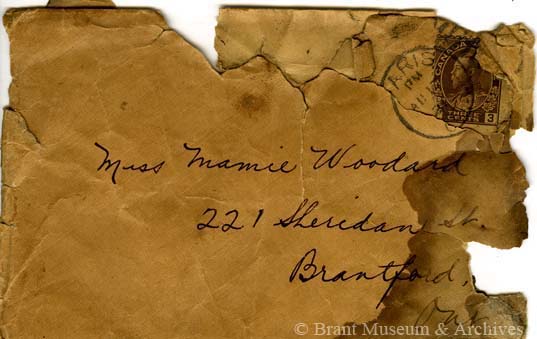
Envelope, in poor condition, dated 1921

Imagine if an email or text message of yours could end up in a museum 90 years from now. What would researchers find? What sort of little things do you mention to friends on a daily basis? If my text messages from this past week were to be uncovered, people would see quick messages from my mum before she caught a flight home, giving directions to a colleague, and texting a friend back and forth about getting together to make peach jam (it's canning season, after all).

But digital communication is so ephemeral. What will future generations know about us and how we communicated? We (most of us anyways) don't print off our text messages. What clues will future people have when they are conducting their own research? We're fortunate to have letters, a form of communication which has mostly fallen by the wayside excepting for business and sometimes legal reasons. Letters are lovely. They are solid, physical pieces that can be examined for the kinds of clues and hints that researchers love.

This letter, addressed to Miss Mamie Woodard and dated summer 1921, was one of the very first things I catalogued when I started working at the Brant Museum & Archives as a summer student a few years back. I was so charmed by the little note (which is in fact several pages long) I spent some extra time researching the details and carefully scanning the pieces for our digital database.

Check into the BHS blog every week: we'll be releasing new pages of this letter in a 6-part series along with transcriptions and research notes.

In the meantime, do the future a favour: send a couple letters, and maybe keep a few of the letters and cards you receive for later generations. And for goodness sakes, put a date on them!

- Carlie

Tuesday, 11 December 2012

Status of Wealth in 19th Century Homes


Myrtleville House is not the typical 19th Century home. The Good’s built a Georgian Style Home, complete with 10 rooms and 7 fireplaces. The cost to build Myrtleville was four hundred and sixty seven pounds, five shillings and nine pence half penny, which is equal to about sixteen thousand dollars today. When pioneers traveled to the new world they would build a log cabin, due to their budget and time restraints, so to find a home of this size and grandeur, it's evident that the Good family was quite well off.

While touring an 1800s home, there are several signs of wealth you can keep an eye out for, such as:


Books- very expensive, and also more likely to be used by families with leisure time.

Painted floor boards-a luxury that added beautification to a home.

A multitude of windows, doors , and rooms in the home- People were taxed on the number of rooms, doors, and windows in the home. As a result, many 19th century homes did not have closets. Closets were considered a room, so to cut back on the cost they would use wardrobes.

More than one story- usually homes in this time period were built as a half story. From the outside, Myrtleville House appears as if a single story; however, it is really two.

Tall white sugar cone. The larger the sugar cone the wealthier you were. A sugar cone cost $100 in 1811. They would place their white sugar cone on the window sill to show neighbours how wealthy they were.

Tea Chest – Tea was very expensive, and therefore enjoyed only by the wealthy.

Come visit Myrtleville House, and see how many of these signs of wealth you can discover!

Friday, 9 November 2012

Chair of the Valkyries


Working in a museum isn't all lace doilies and petticoats. Some artifacts found in the storage areas of the museum can be described as unsettling, disturbing, or just plain scary. Generally speaking, I've gotten used to some of the less quaint artifacts that the museum houses, but every now and again I’ll find an artifact that makes me nervous.

For example, this chair. This chair makes me nervous. It’s found a home in a storage room and has been there for quite some time, but it still surprises me every time I open the door. Staff members have taken to giving the object pet names such as “Satan’s Chair”, “Demon Chair”, “Loki’s Chair” and “Seat of the Damned”.

Part of our collective discomfort may stem from the fact that we know so little about the chair. It was donated in 1962, and was described as being “many years old”, which though true is peevishly vague. The piece is crafted out of black-lined brown leather which is button-tucked in places, and pairs of animal horns styled around the edges. Even the feet of the chair are embellished with horns, though supported with cylindrical brace bars. The estimate is that this chair is probably from the early to mid-1800s, and it’s my personal guess that it belonged in a gentleman’s office, billiard room, or hunting cottage, simply because no Victorian lady of taste would possibly have let this object into their parlor or salon.


The research for this piece suggests that the horns are from buffalo, but pieces of horned furniture, which were popular throughout Europe and North America in the 19th century, could be crafted with the horns of any animal, including elk, moose, and even cattle. Its provenance is likely similar to a mounted moose head or bear skin rug, as generally, items like horns and animal skins were used as trophies as signifiers of a successful hunting trip.

The chair lives in an upstairs storage room. I've taken to calling it the Chair of the Valkyries, because it reminds me of the typical depiction of an opera singer with a horned helmet, especially typical of Wagner’s opera Die Walküre, specifically the third act’s “Ride of the Valkyries”. Also, Elmer Fudd in the Looney Tunes cartoon “What’s Opera, Doc?” who sings “kill de wabbit!” to the tune of Wagner’s most recognizable piece.

So the chair doesn't belong to a villainous demon, plotting anti-hero, or a mythic Norse soprano, and instead likely originated from the private quarters of a wealthy Victorian gentleman with a penchant for hunting. It still creeps me out.


Carlie M.
Program Coordinator, Brant Museum and Archives

Monday, 29 October 2012

The Harvest Moon

Harvest season was a very busy time of back breaking work for pioneers. Today, farmers can harvest their crops quickly and easy by using modern mechanized farm equipment. But for the pioneers, fall was a busy season, as all members of the family had to participate in order to ensure there would be enough food to survive the winter. It would start in late August, beginning with the wheat; pioneers would harvest the wheat by hand, cutting it by using a sickle or a scythe. The stalk of wheat was turned into straw, which could then be stuffed into mattresses or used as bedding for animals. The harvester that farmers use today combines many steps that the pioneers had to do by hand. After cutting the wheat and placing the stalks in shocks to dry, pioneers would need to separate the kernels from the stalks, using a piece of equipment known as a flail.
Flail

Winnowing Tray
 The kernels would land on the barn floor and would be swept up up and placed in a winnowing tray. Winnowing was done on a windy day. This process would separate the wheat from the chaff. Eventually, a fan mill was used to separate the wheat kernel from the chaff rather than relying on nature to provide the wind power. Farmers would then take their wheat to the Grist mill, and grinding stones were used to grind the wheat into flour. Again, natural resources were used as the grinding stones were usually powered by a waterwheel. Today, we have flour mills that grind wheat into flour by using a roller mill. Corn was also harvested by using a sickle or a scythe.

The fall was also a time when animals were slaughtered. The meat was hung on hooks in the smoke house and smoked for several days before being preserved by salt. The soft fat from pigs was used to make soap, and beef or sheep fat was used to make tallow candles. Vegetables and fruits from the garden were preserved with sugar, salt, and spice, while herbs and apples were dried. Females in the family spent many hours preserving and pickling food for winter storage. Many families would host a harvest bee where neighbours would come and help each other with the work and it would finish off with a barn dance after.

Farmers planned to harvest when there was to be a full moon, so that they had enough light to work until midnight, if necessary. In September, the full moon seems to linger in the sky for several nights in a row; hence, the expression, Harvest Moon.

School groups can learn more about Harvesting during our “Harvest Moon” Program presented at the Myrtleville House Museum. Students get the opportunity to take tour of the workshop, shell corn, make apple cider with our apple cider press, bake apple cookies, and learn about the harvest season with this program.

Fanning Mill
For more information about booking programs, please visit our website or call Lisa Anderson, Education Officer at 519-752-3216 or Lisa.anderson@brantmuseums.ca

Monday, 15 October 2012

Traditional Healing Herbs

Aloe Vera
Life in 1812 was anything but easy. It was a struggle to complete the daily chores, and survival was incredibly laborious. The daily struggle was often compounded by diseases, accidents and injuries, that we may now view as insignificant given our multitude of available medicine. In the early 19th century, any community in Upper Canada that had a physician living within 10 kilometres of town was considered fortunate, but even then, response to a medical emergency could take hours or even days if the doctor was making a round of house calls. Before this time, traditional doctors didn't exist in Upper Canada. Women were the healers of the earlier European settlements and could make up home remedies to aid the sick or injured. The knowledge of herbs and natural remedies was often times passed down through generations by mothers, as well as learned from the First Nations communities.

Below is a list of natural elements that would be used by early Canadians to make up home remedies to help ease what ailed them.

Aloe Vera
Properties: Soothing, cleansing, and vulnery (wound healing)
Uses: Burns, Sunburns, infections, and wounds

Chamomile
Burdock 
Properties: Alterative (to restore health), Diaphoretic (Inducing perspiration), Diuretic (to increase the flow of urine)
Uses: Blood Purifier for acne, eczema, boils and rheumatic infections

Calendula 
Properties: Antispasmodic (to stop spasms), diaphoretic, and vulnery
Uses: Cramps, colitis, skin boils, and fever

Chamomile 
Properties: Anodyne (pain killing), antispasmodic, carminative (relieving flatulence), sedative (inducing calm or sleep), stomachic (increase appetite), and tonic (create feeling of well being)
Uses: Headaches, insomnia, and menstrual cramps

Catnip 
Properties: Anodyne, antispasmodic, carminative, diaphoretic, emmenagogue (stimulates menstrual flow), and vermifuge (to destroy parasites)
Uses: flatulence, insomnia, headaches, worms, and nervousness

Cayenne 
Properties: Carminative, irritant, stimulant, and tonic
Uses: Congestion, sore throat, colds, circulation, and digestion
Eucalyptus
Camfrey 
Properties: Astringent (contracts tissue), cell proliferant (cell growth), demulcent (soothes), expectorant (clears mucus), moisturizes, styptic (stop bleeding), vulnery
Uses: Anemia, congestion, hay fever, hemorrhage, and bone troubles

Dandelion 
Properties: Depurative (remove impurities), diuretic, stomachic, tonic
Uses: Anemia, eczema, circulation, warts

Elder 
Properties: Bark: Catharic, stomachic
Flowers: Diaphoretic, emollient
Uses: Fever, flu, kidney, skins, Caution: all parts of plant can be poisonous especially if not prepared with heat.

Eucalyptus 
Properties: Antiseptic, expectorant, stimulant
Uses: Oil added to sauna or steam bath, aids respiratory ailments. Diluted extract is anti-septic

Garlic
Ginger Root 
Properties: Carminative, diaphoretic, diuretic, stimulant
Uses: Chest and stomach spasms, suppressed menstruation, body resistance, diarrhea

Garlic 
Properties: Antibiotic, carminative, diuretic, expectorant, vermifuge
Uses: Bronchitis, colds and flu, liver and gall bladder problems, digestion, body resistance

Ginseng 
Properties: Demulcent (relieves irritants), stimulant, tonic
Uses: Central nervous system, longevity and vigor (especially for men)

Golden Seal 

Properties: Antiseptic, astringent, diuretic, laxative
Uses: Mucous membranes, buildup of mucous, colds, bites, gum and mouth sores

Golden Seal


Mint 
Properties: Antispasmodic, carminative, stomachic, stimulant
Uses: Cramps, digestion, colds, circulation, fevers

Raspberry 
Properties: Demulcent, purgative (laxative), vulnery
Uses: Menstrual cramps, diarrhea, morning sickness, other symptoms of pregnancy 


To learn more about how pioneers used these natural resources, read Mr. Carroll's Concoctions. 

Monday, 1 October 2012

Celebrating Myrtleville House


             On November 22, 1836 Allen Good and his family; wife Eliza, daughter Anne, and sons John and Charles, left Cork, Ireland for Canada. They first moved to Montreal where Allen had been appointed Bank Manager for the Bank of Montreal. By 1837, Allen had been let go and they decided to relocate to Brantford, Ontario where he had previously purchased 108 acres of land. His family, now including a new daughter Charlotte, made the difficult journey to Upper Canada.
             Upon arriving in Brant County, the Good family stayed in a rental house for some months at the corner of Colborne and Dumfries Streets. Allen began drawing up contracts for their new family home which detailed a two-story, nine room house with seven fireplaces and no cellar, at the cost of four hundred and sixty-seven pounds, five shillings and nine pence halfpenny. This is equal to about sixteen thousand dollars today.
Myrtleville house was designed after a home in Ireland with the same name. It had been owned by a Thomas Daunt, a partner to Eliza Good’s Father, Mr.Carroll. The original house was a country home located on the bay of the Atlantic that got its name from the green myrtle shrubs which grew all around it. As a child Eliza spent many holidays at this house and no doubt wanted to bring a little piece of Ireland to their new home in Brantford. The Canadian Myrtleville house was given the same name and built in the same Georgian style with stucco siding, which was well out of fashion by this point.
The property was passed down through generations of the Good family and in 1903 William Good, the grandson of Allen Good was in possession of the farm and house. Ten years later William Good began construction of a new house on the current property next door to Myrtleville house. This house, unlike the original, was to be equipped with all the modern conveniences of the time. This included a coal furnace; stationary washtubs, bathroom upstairs, hot and cold water in the kitchen, laundry, and bath. Although the house was wired for electricity it did not receive it until 1917 when the Hydro-Electric Power Commission of Canada was created. The first house’s main use from then on was as a summer home for family visitors, or for farm hands to stay.
William married Jennie in 1908 and purchased the Myrtleville property from ‘Aunt Annie’; after her death he became the figure head of the family. When William took over operations of the farm he started to make improvements such as the addition of an orchard. In 1921 William was elected to Parliament for four years. While he was away he put the farm on hold and rented out most of the property to a family. In 1925 William retired from politics and returned to Myrtleville. He was ready to go back to the family legacy of farming. He maintained his position as President of the Cooperative Union of Canada which he started in 1921, as well as being on the Board of United Farmer’s Cooperative of Ontario. When he returned to farming he built up a herd of purebred Holstein-Friesians and began what would come to be a dairy farm.
During the Great Depression William hired as many men as he could afford to help out on the farm and brought fruit to the Social Service Centre to be distributed to the unemployed. Jennie was also a very practical and thrifty woman, obtaining many unbleached soft muslin bags used to transport unprocessed silk from Japan and constructed sheets, nightclothes, and aprons for her family.
           Upon William Good’s death in 1967 the possession of Myrtleville was passed on to his son Robert Good. Many restorations in the 1960s preserved the homestead and began considerations of donating the house as a museum. In 1978 the documents were signed that donated five-acres of land, containing two houses, a swimming pool and a number of octagonal silos, to Heritage Canada.
           Many of the artifacts in the museum have found their way back to Myrtleville from previous family members. Original pieces from Eliza Good such as the big four poster bed in the master bedroom, her Collard piano now located in the parlour, and the dollhouse they gave to their daughter Anne still remains in the house. Likewise, William Good’s handmade camera still remains in the library along with shelves and shelves of books that the Good family enjoyed.
          Along with being a great example of living history of the Good family , Myrtleville has remained a place of learning and family gathering. The property is host to camps that are run throughout the summer and school year as well as annual celebrations such as the Easter Egg Hunt, and the Family Day event. Myrtleville house has changed over the years, but one thing has always remained true: Myrtleville is a place of family and community, a place of gathering for everyone.      Once upon a time Myrtleville was a place of learning and gathering for the Good family; now Myrtleville has come to encompass a broader family; that of Brantford.
           Visit Myrtleville House today to see 175 Years of Myrtleville: A Story of Family, Community and Nation on display now.